Wednesday, 23 November 2016

Exploring the Southeast

July 24, 2016

We were finally in position in the Southeast portion of the state, and my first lifer of the trip was tallied before I even got up out of bed: a singing Mexican Whip-poor-will. Split from the eastern population in 2010, these birds are distinguished by their lower, burrier song. Here's a video recording I snapped of it singing in the moonlight.


Camped up in the oak-pine forest in Bear Canyon of the Santa Catalinas, our plan was to head downwards as soon as we were ready to spend the morning birding the saguaro desert. However, we couldn't simply ignore all the life birds flitting through our camp, so we spent an hour birding nearby. A few Yellow-eyed Juncos were feeding around the parking lot, as were a gorgeous adult Painted Redstart and a juvenile following its parent around. Man, and I thought our American Redstarts were flashy! Stark black, white, and red, they're very acrobatic feeders like our American ones but flash bright white outer-tails instead of orange. A poor look at a Bridled Titmouse, a raucous trio of Mexican Jays and a heard only Hepatic Tanager rounded out a 6-lifer start to the day, but we needed to leave better looks for another time since we had desert birds to find.

We arrived at our piece of desert near Reddington Pass at quarter to seven, but found things quieter than we were  expecting. Ash-throated Flycatchers, Black-tailed Gnatcatchers and Black-throated Sparrows were numerous, but these were birds we were familiar with from the Great Basin and the Mojave; we'd come this far south in search of different targets. Still, the towering saguaros and chugging songs of Cactus Wrens set a gorgeous scene, the later a lifer for Kayla and Ned and my second time encountering these massive, charismatic wrens.


Compared to the barren Mojave, which is sparsely inhabited by Creosote, a few other shrubs and the occasional Joshua Trees, the Sonoran looked like a jungle! While the saguaros were obviously impressive, the sheer abundance and diversity of all the other cacti and shrubs down here made for a really rich desert environment.


While most of the saguaros were not flowering yet, many of the Pancake Prickly Pears were, adding bright pink to the sea of greens. A park warden that we chatted with told us that the ocotillo had been barren up until less than a week before we arrived, when the rains had allowed them to leaf our in a matter of a few days. Truly incredible how quickly the monsoons can bring the desert to life.

Pancake Prickly Pear in bloom, in front of ocotillo and saguaros
Photo Credit: Kelly Colegrove 

We wandered up the road, scouring the area for new birds. Ned spotted a flash of red in the shrubs, the southwestern subspecies of Northern Cardinal, but unfortunately we didn't get a good look (funny how one get's a new appreciation for them when you haven't seen them all summer). Further up we got some glimpses of a few more cardinal-like birds chasing each other through the shrubs. The brief looks we got showed the birds might not have been entirely red, suggesting they might have been Pyrrhuloxia, the difficultly-named cousin of the cardinal and one of our targets. However, I seemed to remember hearing that the southwestern cardinals were paler than the ones out east, so as we waited for another look I explained to the crew that they might have just been cardinals. Excitement was high, and as I was thinking out loud of how to identify the birds said "Wait, what does a Pyrrhuloxia even look like??". That got a good laugh and went down as one of the quotes of the trip. In the end one of he birds popped up for a good view, and it was in fact a stunning male Pyrrhuloxia.

"What does a Pyrrhuloxia even look like??" Also note Maebe's sun-retardant white t-shirt
Photo credit: Kayla Henry 

Woodpeckers were also on the hit-list, since both Gilded Flicker and Gila Woodpecker would be new for Kayla, Ned and I (I should mention that Kelly used to live in Arizona, so had seen most of the birds before). In the absence of trees they use the saguaros to nest here, so we continuously scanned the sides of the massive cacti. The trunk of one of them had collapsed and looked like an elephant's trunk.

Elephant saguaro
Photo Credit: Kelly Colegrove 

Even after the mostly-fleshy cacti died, they left behind their rib-like skeletons.

Saguaro skeleton

A handful of Ladder-backeds were around, but the closest we came to the flickers were a couple vocalizing birds that we couldn't get eyes on. Although Gildeds are the default in this habitat the two flickers sound almost identical, so we didn't want to count them as heard-only. On our way back Kayla finally picked us out a pair of Gilas on a distant cactus, one of her most-wanted birds for the trip, and we all got good looks.

Also near the end of our hike we spotted a Varied Bunting that gave us poor views atop a cactus, but good enough to see that it was a very dark bird with maroon on its head and breast (not a common combination). While not the most satisfying to ticks, a tick it was, my fourth for the hike and tenth for the day. And it wasn't even breakfast!

Well... we were overdue for breakfast. After skipping supper the evening before and birding a chunk of the morning away, we were all pretty famished. We headed into Tucson to a burrito place Kelly knew about, and on the way Ned and I joked about going up to the counter and saying "I want your largest burrito, and can you make it bigger?". Well sure enough, as we walked up to Tania's we were greeted by this sign:

The answer to our prayers

Ned and I just looked at each other and knew we had to put our money where our mouths were. We ordered "The B. Rex" and they brought out a burrito bigger than my head.

Ned with the B. Rex

Even splitting it between us, each half gave us two solid meals each and it was the only thing we ate all day.

Quite the meal!

Our destination for the evening was the fabled Chiricahua Range a few hours east near the New Mexico border, but on our way we took a detour to make a few cultural stops at the towns of Tombstone and Bisbee. On our way east on I-10 we scrutinized every Turkey Vulture to try to turn them into Zone-tailed Hawks.  While we were yet to succeed on that front, a surprise was a pair of Mississippi Kites I spotted circling over the highway west of Benson. Not a bird I associate with the West, but a small population breeds in south-central Arizona. These were life birds for everyone in the car except me, who'd lucked out on working in Manitoba the year when Canada's first breeding pair settled in Winnipeg of all places.

We made it to Tombstone and had a quick walk in the Wild West town. The main attraction was the Bird Cage Theatre, which was home to countless gunfights back in the day and is now apparently haunted.

Bird Cage Theater in Tombstone
Photo Credit: Kayla Henry

The next stop was Bisbee, an artsy town nestled in the mountains down near the Mexico border.

Main street in Bisbee
Photo Credit: Kelly Colegrove 

These weird flies were all over town

Our main draw here was the Beast Brewery, where we spent a bit of the afternoon.

Beast Brewing Company
Photo Credit: Kayla Henry

Later in the afternoon we made our way around the bottom end of the Chiricahuas and up along the state line between Arizona and New Mexico. Here the arid grasslands were supposed to be pretty productive, so we stopped to try for Aimophila sparrows. We walked down a dirt track and were lucky enough to get great views of a Scaled Quail as it scurried our across the road right in front of us. While waiting for the sparrows to reveal themselves we watched our first monsoon storms rove across the grassland, and soon enough we heard a few Cassin's Sparrows giving their flight songs and got good looks at a silent Botteri's Sparrow.

Monsoon storm

Finally we headed up into the mountains and reached our camp for the night. Since we could see a large storm advancing on us from the east we decided to put up our tents after it had passed (no sense getting them all soaked), and instead headed up the dry creek to look for birds.

The Chiricahuas

It was cool to see yuccas and cacti among the oaks in the forest here

Things were very quiet, but we soon picked out the melancholy whistles of our lifer Dusky-capped Flycatchers and got to watch three birds chasing each other around the sycamores. Then it started to rain, so we turned around hiked back to camp. Just as we arrived a bird flew over our heads across the parking lot. I got on it late and only saw a large-ish dark bird with white outer tail feather, which almost reminded me of a giant towhee. But Kelly and Ned got on it first as it passed above us, and saw ruby-red below. An Elegant Trogon, in our camp!!! We searched the patch of woods it had flown to but unfortunately couldn't get another look. Damn, not the way I wanted my lifer trogon, but at least we knew they were around.

The rain started to fall harder, so we took shelter under the bathroom roof and watched the storm come in.

Sheltering while waiting for the storm

And come in it did! After dark we were assaulted by our first big monsoon storm, and it was the most intense thunderstorm I'd ever experienced. After the storm hit us the sound of thunder never subsided, since as soon as one boom began to fade a second lightning strike would add a second one in on top of it. We sat in awe under or shelter as the rain poured down and the thunder roared around us. Here's a  video clip to give a feel for it.


Now you may remember that we had assumed this storm would pass over us quickly, after which we would set up our tents and go to bed. Well, one hour passed, then two, and the storm just intensified. We began to second-guess our judgement call. As the rain blew under our roof we all retreated to the Subaru and waited another hour there, hoping it would slow down so the four of us wouldn't have to spend the night in the packed, humid car. After a while my fatigue overcame my patience, and I braved the rain and set up my tent under the bathroom roof before moving it out into the parking lot.

Luckily for the rest of the crew at this time the storm weakened a little, so the girls were able to set up their tents, Ned climbed into mine, and we rested up for the next morning's birding in the famous Cave Creek.

Sunday, 20 November 2016

Heading South

Hello again everyone! I've had few months' hiatus from posting, but now that I'm back in Southern Ontario for the winter and have some free time I'll try to catch up on my past three months' adventures. And with the the first dose of winter hitting us today here in Ontario, why not warm up again with tales from hot and sunny Arizona?

At the end of this summer's season on the Nevada Bird Count I had the opportunity to make a trip I'd wanted to do since my first season in the project: a monsoon visit down to SE Arizona. In late July into August thunderstorms sweep through the state daily, adding moisture to the parched environment and allowing the plants, birds, herps, and other wildlife to flourish. During this 'second spring' many of the birds are in full song (unlike most places at this time of year), and many species of hummingbirds are either making their way from the north or coming up from Mexico. In addition to the birds, I was almost more excited for the herping in this region, as the storms allow frogs, toads, lizards, and snakes to be more active than in the hotter, drier part of the summer. Rattlesnakes in particular were one of my main goals, as Arizona hosts an amazing 11 species of these impressive venomous critters.

This year I was lucky in that my co-workers Ned Bohman and Kayla Henry had some free time before going back to work, and Kelly Colegrove from GBBO's Crescent Dunes project decided she and her dog Maebe could take some time off to join us as well. So plans were set, and after being set free on our last Friday of work we made plans to head south for Arizona!

Friday July 22, 2016

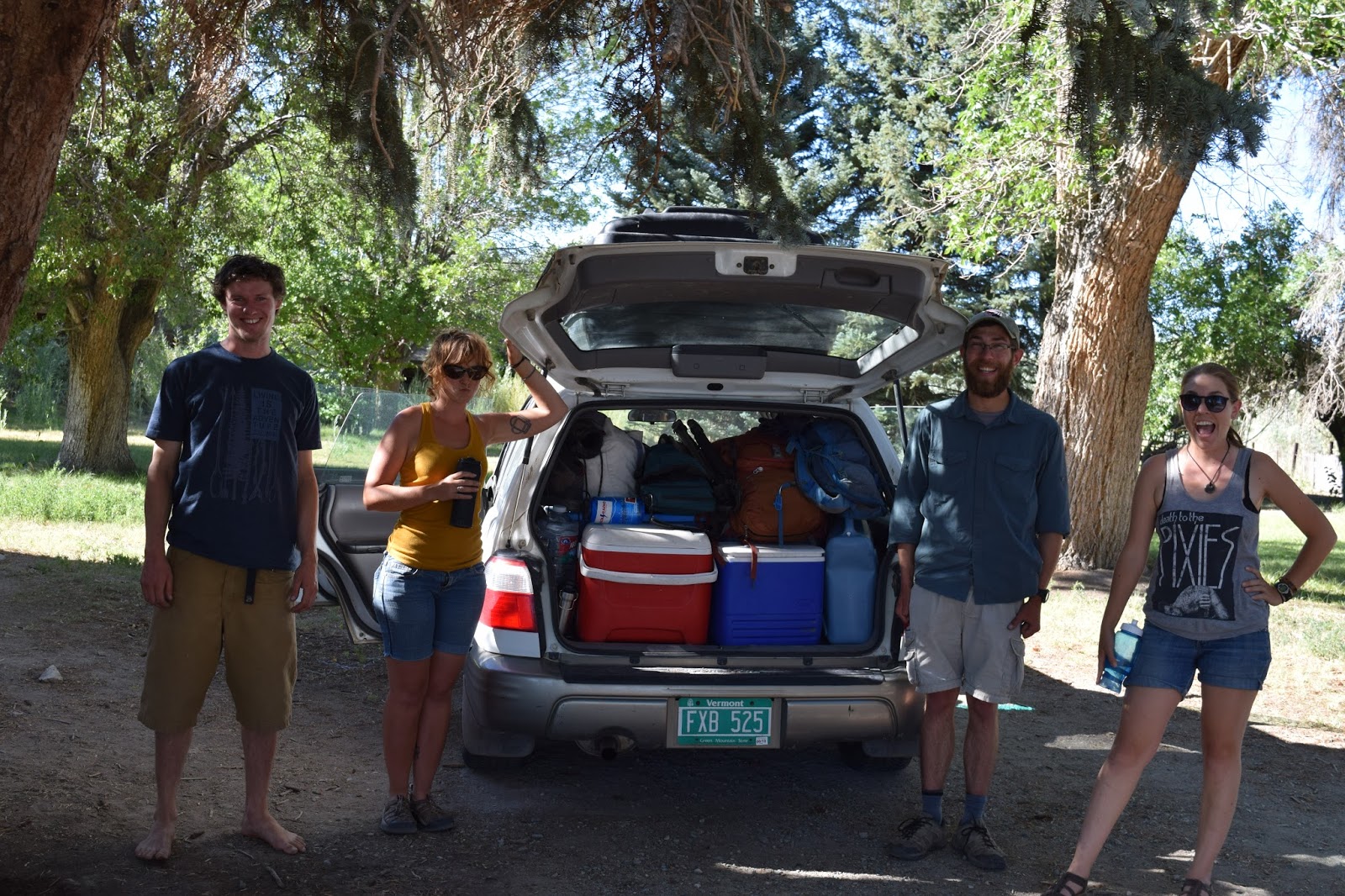
After our season end lunch in Reno was had and loose ends were tied up, we headed back south at a later-than-hoped-for 3:30pm to Yerington to load up Ned's trusty steed, Sally Suby, with all of our gear. Ned's friend Nai joined us for the first leg of the journey, since her car had broken down in Tonopah the week before and she needed a lift. It made for a tight fit, but we packed up the car tetris-style and in about an hour we had packed and continued on our way.

The Crew: Ned, Kelly, me, and Kayla, with a well-packed Sally Suby

When we added Nai and Maebe the dog it was a tight fit! 

The ride down was a long one, but it passed easily with good tunes and good company.  Around dusk we pulled into Tonopah to drop off Nai with her rig, then the four of us continued on towards the Mojave. Our original plan was to stop around Las Vegas for the night, but as Vegas came up we decided to push for Arizona and make ground while we had the stamina. By 1am we made it to Boulder City and, having missed all the fast-food turnofffs in Vegas, had dinner of an egg salad sandwich and a large loaf of garlic bread in the lamp-light parking lot of a 24h grocery store. It was starting to feel like a real road trip!

Parking lot dinner at 1am
Photo credit: Kelly Colegrove

We soon crossed the Colorado River which marked the border of Arizona, and continued on for another hour before crashing in a picnic area in the Hualapai Mountains for a brief sleep.

Saturday July 23, 2016

At 6am we were up again, with very few birds singing and none of the hoped-for Hepatic Tanagers, Painted Redstarts, or Olive Warblers that mark the NW edge of their range in these sky islands. We packed up camp quick before the wardens woke up and made their rounds, and soon were on our way towards Flagstaff for breakfast. As we climbed up into the mountains and neared the town we entered back into the Ponderosa Pine forest. After some breakfast burritos at a local coffee shop we headed to a nearby park to bird a bit and stretch our legs. Lucky for us, immediately after stepping out of the car we heard the squeaky voice of a Lewis's Woodpecker. This was Ned's nemesis bird, and we were all happy to join him in celebration and watch the gorgeous woodpecker in the pine above us.

Lewis's Woodpecker

Ned, Kayla and I FUTSed around the Flagstaff Urban Trail System for a while and enjoyed the montane birds while Kelly took Maebe to the dog park to burn off some steam. There I saw my first of the Red-backed subspecies of the Dark-eyed Junco in addition to some Pygmy Nuthatches, Mountain Bluebirds, and a nice male Red Crossbill showing well as it fed on the ground. Another treat was my lifer Abert's Squirrel, with long fuzzy tufts on its ears leading to it's other common name, Tassel-eared Squirrel. No photos of it unfortunately.

Ponderosa Pines in Flagstaff

In town we bumped into an entertaining crew member from Ned's work on Desert Tortoises in the Mojave last fall, so we chatted with/listened to him for a while before continuing on south through the mountains. We elected to take a slight detour through Oak Creek Canyon, and despite the swarms of tourists that had invaded it on that weekend day it was still absolutely spectacular. The road runs through a lush riparian canyon surrounded by red rock cliffs, and was definitely worth the extra time. It was really refreshing to see dense oak, maple, sycamore, ash and more, such diversity after working most of the summer seeing only cottonwoods and aspen for deciduous trees.


Near the creek we had a singing Huttons Vireo, as well as a Yellow Warbler that we tried to turn into a Red-faced (we swear it sounded funny). Further down the canyon widened out and transitioned to PJ with some Alligator Juniper which we hadn't seen before.


After passing through the tourist trap of Sedona we were back on the open highway and covering good ground. Soon we began to see signs that we were entering the transition zone between the Mojave and the Sonoran Deserts. An ocotillo here and a palo verde there were all cool to see, but the heralds that sent gasps through the car when they first made their appearance were the mighty Saguaro cacti, the lords if the Sonoran. As we headed further towards Phoenix they be went from ones and twos to dominating the surrounding hills, and were impressive indeed.

Despite venturing deeper and deeper into the American Southwest, it was nice to see a bit of Canadian culture in the form if a road sign Gordon Lightfoot would have approved of.


We arrived in Tucson, the gateway to SE Arizona, in the late afternoon, and headed for the Borderlands Brewery for a snack and a drink. While navigating the roads trying to find it we spotted a prickly pear cactus full of fruit. Apparently Ned had tried them down in the Grand Canyon the fall before and they were absolutely delicious, so we stopped to try one out. I had the honour of harvesting one of the pink fruits and attempting to carefully remove all of the tiny, hair-like spines or 'glochids' with my belt knife before consumption. Ten minutes of ginger work resulted in a few fingers full of irritating spines and a single bite of unpleasant fruit before tossing the rest away. A consolation prize was an emerald-coloured scarab that had been shriked on one of the leaves.

Scarab beetle cashed by a shrike on a prickly pear

After our refreshment stop at Borderlands we headed east through Tucson towards the Santa Catalina Mountains where we would spend the night. The plan was to find a burrito place Kelly knew about on the way for supper, but it turned out to be closed for the evening, so we continued to the mountains without. However, we soon forgot our grumbling stomachs as we gawked at the cacti-covered hillsides in the fading light of the sunset and the view of the desert below.


Photo credit: Kelly Colegrove

Sunday, 14 August 2016

Season End Celebration

Nevada Bird Count Tour 7 Part 3

At the end of the last birding tour of the season, it's tradition that the crew head to some incredible place of Jen's choosing to spend a couple days birding, relaxing, and having campfire cookouts. This year the location was Onion Valley Reservoir, nestled in the Pine Forest Range a bit farther north than our Black Rock survey sites. The crew had come here at the end of season 2 years ago and we'd heard good things about this beautiful site (including the fact that one of the NBCers had a Long-tailed Jaeger on the reservoir that year), so we were excited to see it. Would it really be that much different from the Black Rock/High Rock we'd spent weeks at this season?

Once getting to the road it took us over an hour to climb up out of the dry, cheat-infested salt desert of the flats below up into the range. For most of the drive the incoming ridges hid the glory of Onion Valley from us, but eventually we crested the height of land and were given views of massive aspen stands and pockets of mountain mahogany and pine crowning the peaks. No photo of those first views unfortunately, but soon enough we were in camp next to the reservoir itself.

Camp at Onion Valley Reservoir

On these season end events, each of the crew does have to work in that they need to collect some sort of data, but they are 'fun' surveys. Everyone got the choice of surveying a pre-existing transect, create their own transect, or (the best option) survey a 1km x 1km atlas square. The atlassing essentially entails picking a square of cool country out on the map and then birding it the next day, trying to maximize your species list and track down as many baby birds as you can. No time constraints, distance estimation, temperature measurements etc., just straight birding! Always a refreshing way to end the season.

For myself I chose a section over the closest ridge from camp, with some high-ish peaks on my plot in the hopes of getting some Coniferous Forest habitat. Proper coniferous forest, with Limber Pine and the like as opposed to Pinyon-Juniper, is a real rarity on the NBC, and I was hoping it would produce some fun birds. For instance, the last time the crew was here they found some breeding Hammond's Flycatchers, one of the few places in the state that has them.

That morning, July the 11th, we woke up to temperatures below freezing, which surprised me not only for the time of year but also that we were only a bit over 7000ft. It was tough crawling out of bed, and even tougher clambering up the steep slope with thick vegetation before I even got to my square. It was a pretty rough start, and I had thoughts of just turning around since it was only 'fun' data, but I'm glad I didn't. Even before it warmed up, I was rewarded with some breathtaking views of the reservoir and surrounding hills. A Golden Eagle drifted over the peaks in the dawn light.

Onion Valley Reservoir at dawn

Misty Mountains

But eventually the temperature warmed up, my bones thawed out, the birds became a little more active, and my spirits improved. Climbing up high enough I did eventually reach the Limber Pine, where a group of Clark's Nutcrackers with their fuzzy babies provided some entertainment. I got to watch some 'cracking nuts' as well.

Limber Pine and a snow patch clinging on


And the views got even better as I got higher.


Near the top a family of Mountain Bluebirds was fun to watch. Here's the male blending into the sky:

Male Mountain Bluebird

And one of the three hungry babies:

Fledgeling Mountain Bluebird

As they often are on these high elevation sagebrush patches, the wildflowers were lovely to see as well.

Castilleja and other wildflowers in the sage

The square was quite varied in its habitats, which was great for atlassing. The higher elevations were mostly Limber Pine as I'd mentioned, but in places the hilltops were covered with Mountain Mahogany. These patches looked great for Virginia's Warbler, a bird I've encountered once and that remains on my 'heard only' list, but none made there presences known. Ned and Bobby had similar patches on their squares but struck out as well.

Mountain Mahogany patch

As I made my way down from the peak, I had my highlight sighting of the morning and possibly the season. I was coming the hillside when 10m away a large animal burst out from underneath a pine in front of me. In that first split second I thought by the tan colour it was a Mule Deer, but then its shorter profile, smooth bounds, and long, snake-like tail trailing behind it became clear. The Mountain Lion made one, two, three, four, five bounds of increasing length before disappearing into a thick stand of young aspen. I'd seen their tracks numerous times both of the last two seasons, and they can be found almost anywhere in the mountains of the state, but it takes a lucky moment like that to actually come across one of these majestic cats. While the view was brief, and I didn't get to see its face, coming across my lifer cat at 10m was pretty exhilarating and kept my pumped for the next while. It was running away downslope and I'm not typically too worried about predators (particularly during the bright light of day, as it was now 8:00 or something), but I didn't follow it to try to get a better look haha.

Further down-slope I came back into the aspens, with some creeks winding their way through and a few patches of open sage. Along one of those creeks an angry Slate-coloured Fox Sparrow eventually lead my to its silent fledgeling, and a stealthy Orange-crowned Warbler chipped as it carried food to its own. A pair of Warbling Vireos likely also had young around, but they were being very uncooperative as I watched them and I wasn't able to confirm their breeding.


The lichens on the dead pine are always striking.


Lower down yet I discovered a series of seepy meadows surrounded by willows. A local pair of Red-naped Sapsuckers had put wells into many of the willows, and this attracted wildlife like California Sister butterflies.


California Sister on Red-naped Sapsucker wells

Some excited chirping and buzzing lead me to a family of Rufous Hummingbirds, a female with 3 young. This tour had been interesting with finds of this species, because 3 days before Ned had found a family down on MR-SummerCamp, and the day before Bobby and Kaitlin had found a similar group along BlackRockMahogany. What makes these finds so interesting is that this species has never been confirmed breeding in Nevada. Now, Rufouses (Rufi?) do start migrating early, so our birds could very well have been post-breeding migrants, but the fact that many were still hanging around in their family groups was notable. Perhaps the fact that no one on the crew had any sightings of this species on either of our previous tours up here lends more evidence to these birds not being breeders, but it'll definitely be something for future crews to look our for.

Juvenile Rufous Hummingbird
The meadows opened up even more as I followed the drainage down to the edge of my plot, and here I was able to add Yellow Warbler families to my list as well as White-crowned Sparrows and many more Fox Sparrows. This area rounded out my square and a solid circuit of different habitats, summing up to 33 species for the morning with about a third of them confirmed breeding. A great morning out in the Pine Forest Range!

Mountain meadow

When we got to camp everyone shared their finds from the morning. I have to say my Mountain Lion took the cake, but Bobby found a Northern Goshawk nest on his plot which is pretty high up on the list of awesome. At last season's end-of-season get together I found my first (and only) goshawk nest in the Toiyabes, and I was pretty keen on seeing another one. Kayla had never seen a goshawk, and Ned was always down to track down one of these awesome raptors, so the following morning before heading back south we quested to Bobby's atlas square to find these mighty accipiters.

After driving towards Blue Lake we navigated to the UTM Bobby had given us and quickly found the nest. Bobby had said that the young were fledged but still hanging around the nest while he was there, but on our visit the forest was quiet an the birds were no-where to be found. We were hoping the birds might make it easy for us when they discovered us, coming in screaming with talons drawn, but they didn't materialize so we hiked out of the stand into the meadow above with the hopes of a better view.

Northern Goshawk nest

On our way out a massive accipiter did pass us in the dim dawn light which, through the bins, I was barely able to make out the gray mantle and white eyebrow of an adult Gos. Unfortunately after we made it to the meadow and set up to wait for another fly-by the birds did not cooperate. It was a lovely meadow though, and the sun warmed us on the chilly morning.

Shadows of goshawk searchers

After packing up camp we started the long drive back south. Coming down from the range we had a few Chukar, one of which teed up on a rock for us.


At the turn-off for the main road we made a stop at Gridley Lake, a mostly dry salty playa, to try for Snowy Plovers. A potential lifer for Ned, Kayla and I had only seen the species a few times before so, so we hiked down to the shore to check it out. Sure enough, the plovers were there, chasing the clouds of gnats across the saline puddles of the lakebed. In a distance patch of water there was a much larger group of peeps, Western and Least from what I could tell, accented by a few tall Avocets and Willets.

Gridley Lake

On the way out Ned caught this big Desert Horned Lizard.

Ned with his Desert Horned Lizard

And so ended out last birding tour of the NBC. One heck of a season with an amazing crew, I'll definitely miss Nevada's deserts and mountains, and the birds, critters, and people I met there. Next year I don't see myself returning for a third season in a row, but maybe some year down the line I'll find myself coming back to this great project.

After the season's end Ned, Kayla, Kelly (from GBBO's Crescent Dunes Project) and I headed down to Southeast Arizona, where in my 5 days with them and 7 days on my own tallied 49 life birds, some 20 new herps, and saw loads of awesome things. However, we'll see when I get around to recounting those adventures, since when this posts I'll be up at James Bay for to survey shorebirds for 4 weeks, after which I'll be at banding at Thunder Cape Bird Observatory for another 5 weeks. Too much content and no time to write it! Anyhow, thanks for reading along with my wanderings in Nevada, and hopefully when I get the time I'll be able to get some photos and stories up about the next legs of my travels.